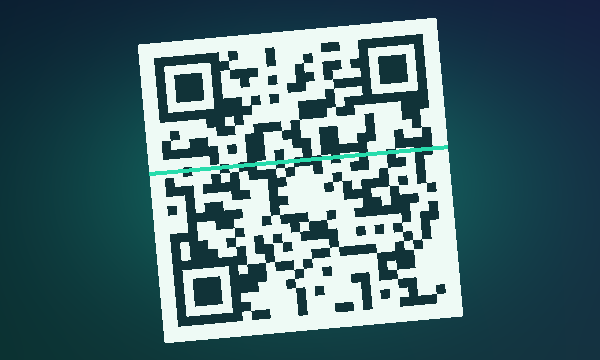
You’ve probably seen a QR code on a café table, a train ticket or a parcel. Some are creased, faded or partly hidden by a logo — yet your phone reads them instantly. That ability isn’t luck. It is an engineered feature.
Those little squares carry more than the message
Unlike a traditional one-dimensional barcode, a QR code stores information across a grid of dark and light squares. The square patterns in three corners help a scanner recognise where the code is, how it is oriented and how to interpret the grid. That’s one reason you can scan a QR code even when your phone is at an angle.
But finding the code is only the first challenge. The scanner must also recover the information inside it, even if some of the grid has been obscured.
The clever part is called error correction
QR codes use a mathematical method known as Reed–Solomon error correction. In simple terms, the code includes extra information that allows a reader to reconstruct missing or damaged portions of the data. Imagine a message that carries enough additional clues for you to work out a few lost words.
There are four standard QR correction levels: L, M, Q and H. They offer approximate codeword restoration capacities of 7%, 15%, 25% and 30% respectively. The higher the level, the more space is used for those protective clues, leaving less capacity for new information.
Important: 30% does not mean you can safely remove any random third of the picture. It refers to the share of encoded codewords that can be recovered under suitable conditions. Covering a crucial detection pattern or introducing awkward distortion may still make a code unreadable.
Why are there three big squares at the corners?
Those are position-detection patterns. They give the scanning software a recognisable shape and help it determine orientation. Their placement makes fast reading possible from different angles. The surrounding light-coloured margin, often called the quiet zone, also matters because it separates the code from visual clutter.
What about QR codes with logos in the middle?
Designers sometimes place a small logo on a QR code and choose a stronger error-correction setting to tolerate the missing area. That can work, but it must be tested at realistic print sizes, distances and lighting conditions. A code that works perfectly on a bright monitor might fail on a crumpled label.
The next time you scan one…
Notice how quickly your phone finds the corners and reads the pattern, even if the code is slightly tilted. You’re watching pattern recognition and mathematical redundancy work together in a fraction of a second.
The takeaway: QR codes are designed not just to store data, but to survive some damage. Their reliability comes from clever maths, not magic.
Sources and further reading
DENSO WAVE: Error Correction Feature
DENSO WAVE: What Is a QR Code?
Cover graphic is a conceptual illustration and is not intended to scan.
Leave a Reply